











Description
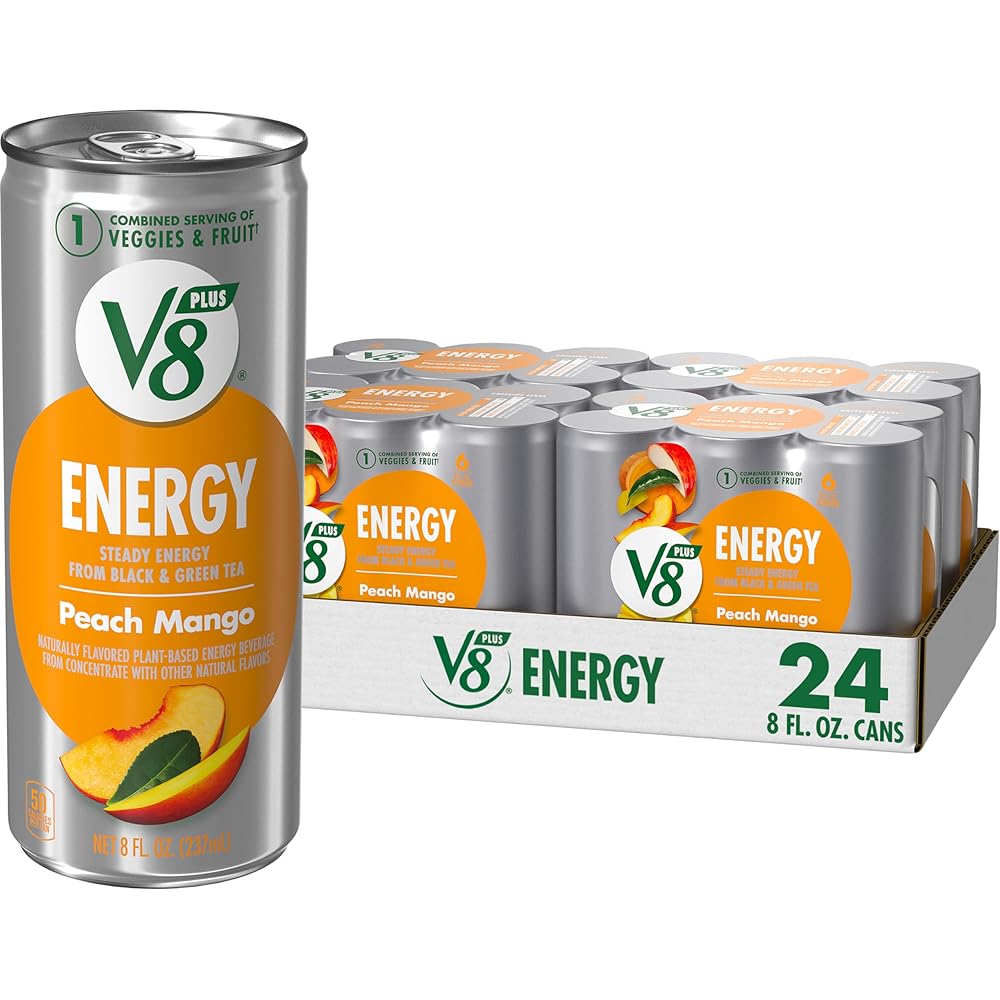
- Twenty-four (24) 8 fl oz cans of V8 +Energy Peach Mango Juice Energy Drink
- A peach mango flavored fruit and vegetable juice blend infused with natural energy from black and green tea
- Each can contains 1 combined serving of veggies and fruit along with 80 milligrams of caffeine – as much as leading energy drink brands
- A healthy energy drink alternative with 50 calories and 12 grams of carbs per can; an excellent source of B Vitamins
- Non-GMO and gluten-free with no sugar added* and no artificial colors (*Not a low calorie food; see nutrition panel for sugar and calorie content)
Mike Murray –
Good product, thanks.
Precise Disarray –
Very very very sweet, from Sucralose and fruit juice. The ingredients are clearly listed on the product page, so I knew what I was getting, but I wasnt sure what overall taste would be like. If you like sweet, then you will get sweet with the orange pineapple option.
I didnt feel much of any energy boost, but I will say that I was motivated to get some chores done, including mowing my grass (with push mower). Sometimes I can tell effectiveness of an energy drink based on that rather than strictly the amped up feeling. This is powered by tea, so the caffeine is more low key but effective. I like that better than other energy drinks that use stuff more likely to make me feel jittery.
While it is way too sweet for me, and I do find it refreshing because of that, I give it 3 stars. BUT, since I decided to add some to a cup of brewed iced tea, it added a perfect amount of sweetness and flavor that I now have a new found use for this. I will still drink it plain if need be, but I like it added to tea (or even carbonated water to make a peppy pop). And overall I like it enough to consider another flavor option (if the price is right). SO.,, 4 stars
Crawford –
I drank these regularly a long time ago. They haven’t been on my recent way of eating, BUT I’ve relaxed some and was reminded of these through a SlickDeals alert. They are high carb and sugary, but taste great and the nutritional label, aside from sugar, is decent. Love the energy boost.
AmazonBuyer –
I seriously loves these energy drinks! But read on…
Contains controversial artificial sweeteners
There is controversy as to the safety of artificial sweeteners consumed over a long period of time. Some studies have linked artificial sweeteners to cancer and other diseases.
If you are consuming artificial sweetened food as a means to reduce calories and lose weight, please consider switching to a less sweet state of mind. Getting your palate used to less sweetened foods over the course of several months will save you the hassle of deciding between extra calories and risk of cancer.
————
Sources:
Bryan GT, Erturk E, Yoshida O. Production of urinary bladder carcinomas in mice by sodium saccharin. Science 1970;168:1238–40.
Arnold DL, Moodie CA, Grice HC, Charbonneau SM, Stavric B, Collins BT, et al. Long-term toxicity of orthotoluenesulfonamide and sodium saccharin in the rat. Toxicol Appl Pharmacol 1980;52:113–52.
Reuber MD. Carcinogenicity of saccharin. Environ Health Perspect 1978;25:173-200.
Murasaki G, Cohen SM. Co-carcinogenicity of sodium saccharin and N-
[4-(5-nitro-2-furyl)-2-thiazolyl]formamide for the urinary bladder. Carcinogenesis
1983;4:97–9.
Hoover RN, Strasser PH. Artificial sweeteners and human bladder cancer: Preliminary results. Lancet 1980;1:837-40.
Soffritti M, Padovani M, Tibaldi E, Falcioni L, Manservisi F, Belpoggi F. The carcinogenic effects of aspartame: The urgent need for regulatory re-evaluation. Am J Ind Med. 2014;57(4):383-97.
Schernhammer ES, Bertrand KA, Birmann BM, Sampson L, Willett WC, Feskanich D. Consumption of artificial sweetener–and sugar-containing soda and risk of lymphoma and leukemia in men and women. Am J Clin Nutr 2012;96:1419–28.
Soffritti M, Belpoggi F, Manservigi M, Tibaldi E, Lauriola M, Falcioni L, Bua L. 2010. Aspartame administered in feed, beginning prenatally through life span, induces cancers of the liver and lung in male Swiss mice. Am J Ind Med. 2010;53(12):1197-206.
Soffritti M, Belpoggi F, Tibaldi E, Degli Esposti D, Lauriola M. Life span exposure to low doses of aspartame beginning during prenatal life increases cancer effects in rats. Environ Health Perspect 2007;115(9):1293-7.
Soffriti M, Belpoggi F, Degli Esposti D, Lambertini L, Tibaldi E, Rigano A. First experimental demonstration of the multipotential carcinogenic effects of aspartame administered in the feed to Sprague-Dawley rats. Environ Health Perspect 2006;114:379–385.
Read: 3 Reasons to Rethink that Diet Coke You’re About to Drink
About Zero-Calorie Sweeteners and Their Risks
For dieters: FoodPoints value is 0
* FoodPoints are calculated by Fooducate based on fats, carbs, fiber, and protein. They are not an endorsement or approval of the product or its manufacturer.
The fewer points – the better.
Lower in calories per serving
The top parameter for weight management is low calorie intake. Beware: Most people cannot correctly estimate their calorie intake because they do not know what portion size they are consuming.
How caffeinated are you?
Here’s an interesting factoid: It takes our body close to 8 hours to metabolize a single cup of coffee. A cup of coffee can contain 65-175 mg of caffeine. The benchmark is 100mg, and the current recommendation is to drink up to 3 cups of coffee per day. Which means that drinking all 3 cups may leave your body continually caffeinated.
How much caffeine are you getting?
Cup of coffee………………………………..………… 65-175mg
Decaf coffee……………………….………………… less than 5mg
Cup of black tea……………………………………… 70mg
Green Tea……………………………………………… 15-50mg
Water…………………………………………………….. 0mg
Sprite (12 fl oz)………………………………………… 0mg
Coke Classic (12 fl oz)………………………………34mg
Diet Coke (12 fl oz)………………………………….45mg
Mountain Dew (12 fl oz)………………………….55mg
Iced Tea (12 fl oz)……………………………………70mg
Red Bull (12 fl oz equivalent)………….……… 115mg
Redline Energy Drink (12 fl oz equivalent)…. 375mg
Cocaine Energy Drink (12 fl oz equivalent)..…400mg
More info from Fooducate
Natural flavors added. Learn why
Companies add flavorings to make products taste better. They are created in a lab and the formulations are guarded as trade secrets.
Flavorings can compensate for flavor loss during processing, substitute for ingredients, lower production costs and increase shelf stability. Natural flavorings are more expensive to source than artificial flavors, but tend to be better received by consumers.
People sensitive to MSG, vegans, vegetarians and those with allergies should pay special attention to the phrase “natural flavorings” since glutamates, animal products or allergens may be the source of natural flavors. You can always contact the manufacturer for more information.
Markcm –
I used to conservatively drink a redbull now and then when I needed a wake me up, I am very caffiene sensitive and have to keep my intake down and periodically take a caffiene break. I was sold on the redbull as it gave me a good boost without side effects like jitters and such. The taste was odd but I got used to it.
Enter V8+ Energy -Bye-bye Redbull!
Taste – The mango and the orange flavors are like a perfectly delicious smoothie to my taste, I absolutely love them. Compare that to the “unique” taste of Redbull that I had grown to tolerate, V8+ wins a million times over. I’ve had a Redbull or two since switching and likely will occationally need a boost and drink a redbull if that’s all that is available in a “break the glass emergency need a boost situation” but I have completely lost my tolerance for the taste and have a new go-to standard in the V8+.
Boost – For me, they have the same caffiene content and give me about the same ammount of boost although V8+ comes from green tea, a more natural approach. Neither give me the gitters although the V8+ does seem to be “smoother” if that makes sense.
Health – I had always felt a bit guilty for the unknow chemical concoction in Redbull, maybe its the marketing but V8+ seems to be a lot more natural and, even while tasting so much better the V8+ is less than half the calories of a Redbull.
Cost – V8+ is much less expensive than Redbull, half the cost if not better. Well, all those millions redbull spends on advertising got to come from somewhere. If you don’t know, do a little research on just how much they spend, its pretty shocking.
Quite a few of my friends and family never took the plung with Redbull due to the “unique” taste and the unknown formulation. I can’t say the same for V8+, most people I offer it too try it and are impressed; quite a few have become regular v8+ drinkers.
Summary – I switched from a casual Redbull drinker to a casual V8+ drinker and could not be happier. I really like the taste, the boost, the cost and feel good about the formulation (what goes into it).
PP –
I used to be addicted to regular soda but now I start each workday with one of these. Tastes great, barely any calories, and gives a boost without overdoing it. I also have one before the gym!